

In today’s digital era, social media isn’t just about sharing vacation photos or catching up with friends. For researchers, it has become a key platform to disseminate knowledge, engage with diverse audiences, and amplify the reach of their work. Whether you’re a senior scientist or just starting out in your research career, promoting your scientific articles on social media can offer significant advantages. Here are three key reasons why integrating social media into your research communication strategy is a smart move:
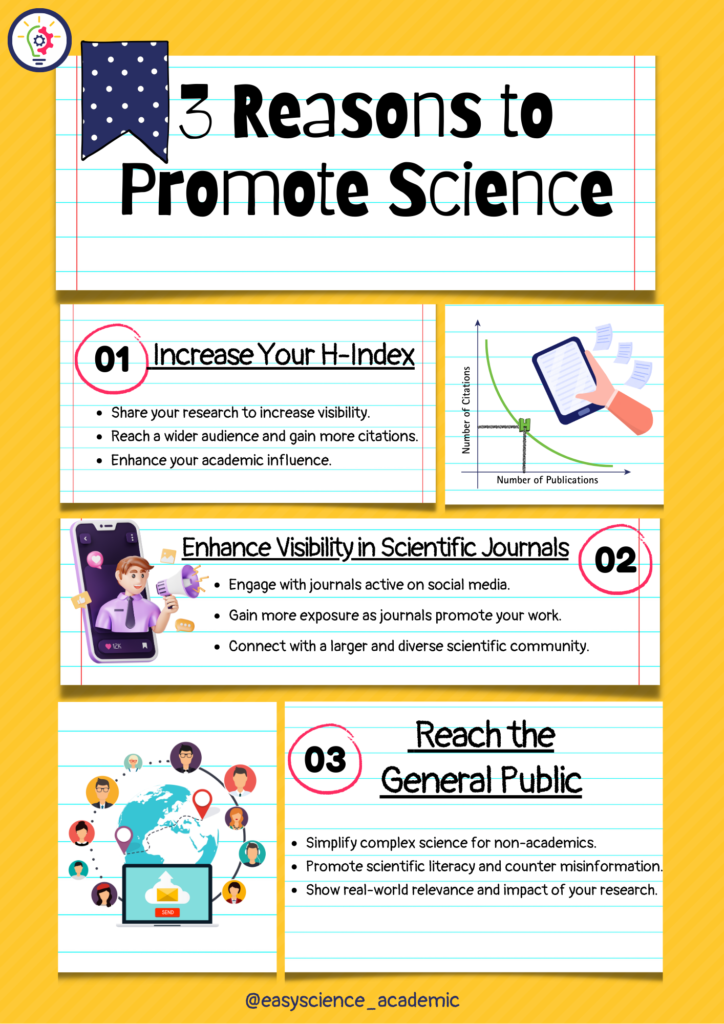
1) Increase Your H-Index
The H-index is a metric that measures both the productivity and citation impact of a researcher’s publications. When your article is shared on social media, it gains visibility among a diverse audience, including other researchers who may find your work relevant to their studies. Increased visibility leads to higher chances of your article being cited, thereby boosting your H-index. Social media platforms are an excellent conduit for your research to reach interested peers quickly and efficiently, enhancing your academic influence and recognition.
The H-index is a metric used to measure a researcher’s work’s productivity and citation impact. Simply put, a higher H-index reflects a stronger academic influence. However, even innovative research can go unnoticed if it doesn’t reach the right audience. Social media serves as a dynamic platform to enhance the visibility of your publications.
When you share your articles on platforms like Twitter (now X), LinkedIn, or ResearchGate, your work gets exposed to a broader and more varied audience than traditional publication channels alone. This includes fellow researchers who may find your study relevant, leading to potential citations. The more your work is shared, commented on, or retweeted, the more likely it is to be discovered by those who might not have encountered it otherwise.
By strategically using hashtags, tagging fellow scientists, and engaging in relevant online communities, you can significantly expand your academic network. Over time, these interactions can lead to an increase in both direct citations and mentions in subsequent studies, ultimately improving your H-index and establishing you as an authority in your field.
2) Enhance Scientific Visibility in Journals
Academic journals today are more active than ever on social media. Platforms like Instagram, LinkedIn, and X have become essential tools for journals to highlight recent publications and engage with both established and emerging researchers. By being active on these platforms, you not only stay updated with the latest trends and discussions in your field but also increase the visibility of your own published work.
Many scientific journals encourage authors to create visually engaging posts or short videos summarizing their research, often featuring them on the journal’s social media accounts. This cross-promotion benefits both parties: the journal enhances its engagement metrics, while your research gains exposure to a broader audience, including those outside your immediate academic circle. Moreover, as journals themselves build larger followings, your work featured on their feeds becomes accessible to a diverse group of readers, from academics and industry professionals to curious members of the public.
An example of a prominent journal in sports science is the British Journal of Sport Medicine, which is recognized for having one of the highest impact factors in the field. The journal shares its scientific articles and content across multiple platforms, including Facebook, Twitter, Instagram and Youtube as well as podcasts, Stitcher and a dedicated blog, ensuring broad accessibility and engagement with its audience.
Engaging in these initiatives also helps advance a sense of community within the scientific field. When your work is featured on these platforms, it can spark conversations, lead to collaborations, and open doors to invitations for speaking engagements or panel discussions. In short, a proactive social media presence can extend the reach of your research far beyond the confines of traditional journal readership.
3) Inform the Non-Academic Community
Academia can sometimes feel like an isolated bubble, where research findings stay within the walls of universities or within the pages of niche journals. However, much of the work being done in labs and research institutions has practical implications that could benefit society at large. By sharing your research on social media, you can help bridge this gap, making science more approachable and understandable for the broader public.
Platforms like YouTube, TikTok, and even Twitter are not just for ordinary audiences; they also attract laypersons interested in science, policy makers, educators, and other stakeholders. When you present your findings in an engaging and accessible way—perhaps through a well-crafted thread, an infographic, or a short explainer video—you contribute to public education and scientific literacy. This is particularly crucial in an age where misinformation and pseudoscience can spread rapidly.By distilling complex scientific concepts into bite-sized, easy-to-understand content, you can demystify your work and show its real-world relevance. Whether it’s clarifying a misconception, explaining a new discovery, or highlighting the significance of your research in everyday life, social media allows you to connect with a non-specialist audience who might not typically read scientific journals. This outreach not only informs but also inspires, encouraging more people to engage with science and perhaps even influencing policy and public opinion.
Conclusion: A Modern Approach to Research Impact
In today’s interconnected world, promoting your scientific articles on social media is more than just a trend—it’s a strategic approach to magnifying the impact of your research. By embracing these platforms, you can enhance your academic profile, increase the discoverability and citations of your work, and contribute positively to society by promoting scientific literacy and awareness.
Social media is a powerful tool that connects the scientific community with the world. Whether you’re looking to boost your H-index, gain recognition in top journals, or simply share your passion for research with a broader audience, these platforms offer an unparalleled opportunity to make your work more visible and impactful.
Explore similar articles on our website and discover tips on how to effectively promote your research through social media. If you’re unsure where to start, contact us! We’re here to help you build a comprehensive media strategy that will help to maximize the visibility and impact of your work. Together, let’s make science accessible, engaging, and truly impactful.